First to Jump by Jerome Preisler
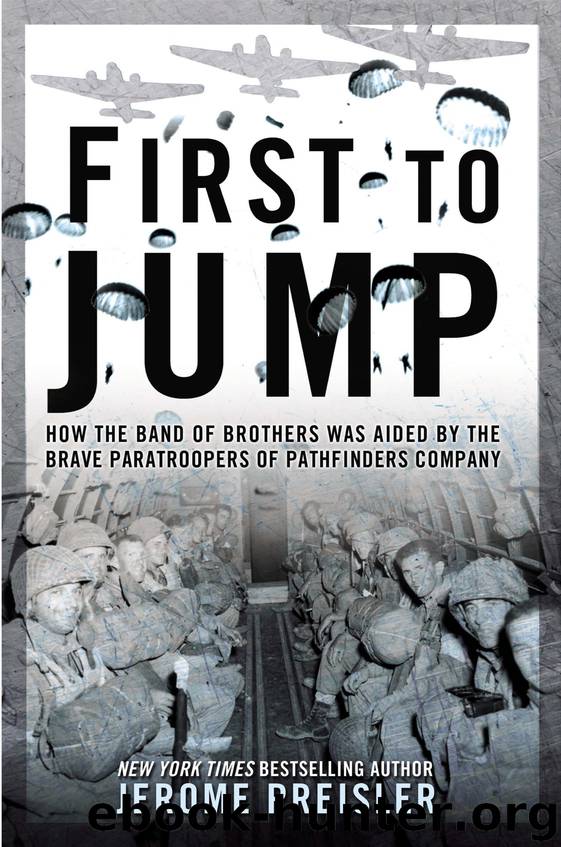
Author:Jerome Preisler
Language: eng
Format: epub, azw3
Publisher: Penguin Group US
Published: 2014-10-21T16:00:00+00:00
4.
It had been a grueling, bloody five days for Jake McNiece, Beamy Beamesderfer, and all the other troopers at the Douve River Bridge.
German infantrymen retreating from the invasion forces on Utah Beach had tried crossing it twice in the first forty-eight hours, but both times the Americans on the embankments of the elevated causeways cut them down. Then, on the third day, U.S. Mustangs flew in, started carpet bombing the area, and took out a chunk of the bridge.
As McNiece later recalled, the pilots had an order to release their extra bombs after their missions. “They were not supposed to return to the runway with live bombs because an accident might destroy ten other planes.” Probably, he surmised, they’d thought the soldiers they saw below were the enemy. He remembered feeling great fear during the runs, then a sense of calm. The men on the ground were powerless to do anything but “wait for the bombs to fall.”
Even after the bridge was destroyed, the Germans kept coming from the beaches. With nowhere else to go as the Allies pushed inland, they would charge the flooded marshes trying to escape, calf- and knee-deep in water. Although vastly outnumbered, the American soldiers held the high ground and kept chopping them down.
McNiece had figured out that one way to avoid getting killed was to stay on the move. The Germans would home in on your fire after a while if you stayed in one place, so he would raise his head up above the embankment, trigger a burst into a group of them, duck, and move on to another spot. He spent most of the next few days doing that and killing Germans. Meanwhile more lost paratroopers and survivors from decimated sticks kept wandering in.
On the fifth day, the enemy soldiers finally stopped coming. The American units that had driven them from the beach arrived, and they’d been pressed in on two sides. Hundreds of them lay dead or wounded in the marsh.
When the shooting ended, McNiece and Jack Agnew took to the field with their weapons—Agnew used a Colt .45 service pistol—and “walked out through there killing the ones that were just wounded or hiding.”
At one point they saw an injured German in a flooded ditch, only his head and shoulders above the water. His chest had been ripped open by machine-gun bullets.
“Give him a shot,” said a chaplain who had caught up to them.
McNiece turned to Agnew. “You’ve got that forty-five,” he said. “Blow his head off.”
Agnew’s first shot missed. Then he knelt, put the gunbarrel to the German’s temple, and squeezed the trigger again, disintegrating his skull.
The chaplain was screaming at them. “You know I didn’t mean to shoot his head off! I meant to give him a shot of morphine!”
“I’ll tell you what, Chaplain,” McNiece said, and looked at him. “You do anything you want to with your morphine. There will be a thousand paratroopers around here that will need a shot of morphine. We are not wasting it on these Krauts.
Download
This site does not store any files on its server. We only index and link to content provided by other sites. Please contact the content providers to delete copyright contents if any and email us, we'll remove relevant links or contents immediately.
The Radium Girls by Kate Moore(12026)
100 Deadly Skills by Clint Emerson(4924)
Rise and Kill First by Ronen Bergman(4785)
The Templars by Dan Jones(4689)
The Doomsday Machine by Daniel Ellsberg(4489)
The Rape of Nanking by Iris Chang(4211)
Killing England by Bill O'Reilly(4001)
Stalin by Stephen Kotkin(3965)
Hitler in Los Angeles by Steven J. Ross(3946)
12 Strong by Doug Stanton(3548)
Hitler's Monsters by Eric Kurlander(3341)
Blood and Sand by Alex Von Tunzelmann(3203)
The Code Book by Simon Singh(3189)
Darkest Hour by Anthony McCarten(3129)
The Art of War Visualized by Jessica Hagy(3007)
Hitler's Flying Saucers: A Guide to German Flying Discs of the Second World War by Stevens Henry(2754)
Babylon's Ark by Lawrence Anthony(2676)
The Second World Wars by Victor Davis Hanson(2524)
Tobruk by Peter Fitzsimons(2516)
